Intelligence Try the demo

Product overview

Inside the client workspace.

Start with a difference between the users or devices you support and the quantities on a client’s agreement. Assign the correction and keep its evidence. When the account comes up for renewal, review what changed alongside service demand, pricing assumptions and open work.

Try a billing review
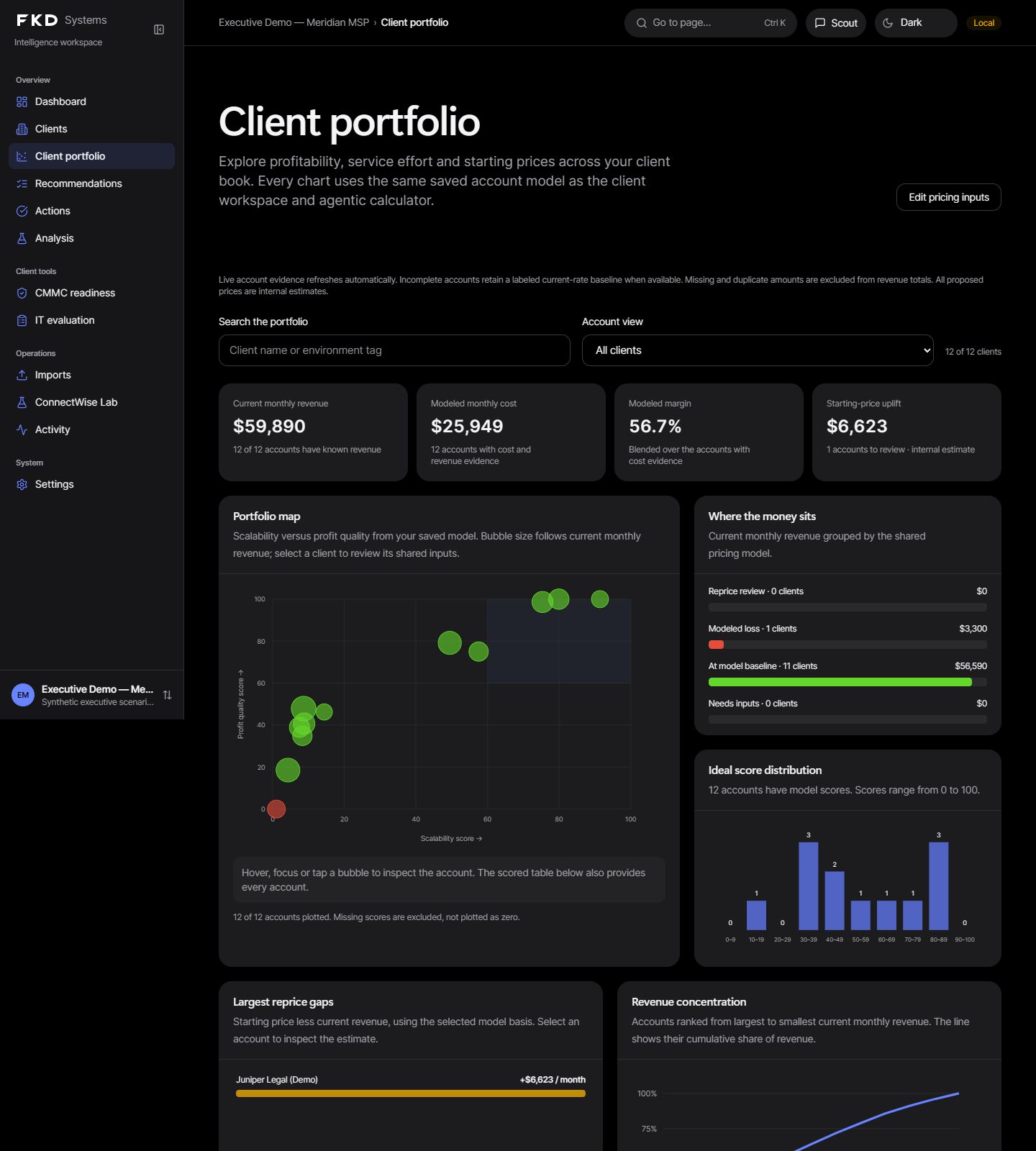
Client portfolioApplication view
Portfolio map from FKD showing fictional accounts by scalability and profit quality. Bubble size represents monthly revenue.
Meridian MSP · fictional portfolioOpen full capture

Billing and operations

Decide what to work on next

An agreement discrepancy starts with a count. An operations lead also needs to know which client it affects, what evidence supports it and who will follow through.

Explore the billing workspace
Open the full recommendation screen for Orchid Workshop, showing the two-seat discrepancy.
Review the source evidence

Orchid Workshop has five supported users and three billed seats. At $95 per seat, the two-user gap has an estimated monthly value of $190.

Northstar Services · fictional workspace
Open the full action detail showing the first result check needs evidence.
Give the work an owner

The operator completed the two-seat correction. The first result check requests fresh exports before it can confirm the change.

Northstar Services · fictional workspace
Open the full result screen showing a Verified quantity check.
Check what changed

The initial check needed more evidence. Complete, fresh exports then supported a Verified result. This establishes the quantity change.

Northstar Services · fictional workspace

Assign the correction

Open the records behind a finding, review the recommendation and assign an action with an owner and due date. After completion, fresh, complete client exports can show whether a supported-user or managed-device shortfall closed. Staff record the commercial outcome separately.

Investigate service pressure

Imported ticket and time records can show recurring ticket patterns or effort above an agreement’s labor allowance. The account team can inspect license drift, security observations and device lifecycle findings alongside them. These service findings need a person to review the result.

Prepare for a renewal

A renewal due within 120 days with an unresolved high- or critical-severity finding can surface for review. Use the underlying issue and agreement dates to decide who should speak to the client and what to address before renewal.

Account planning

Bring the assumptions to a pricing discussion

Portfolio and shadow pricing

Compare service effort, modeled costs and contribution across clients. In a client’s shadow pricing view, inspect the inputs behind aggressive, target and premium scenarios. A temporary what-if leaves the saved price intact.

Missing time, cost or historical quote evidence limits confidence. Validate the inputs before issuing a quote or relying on a modeled margin.

Scout and IT evaluations

Ask Scout about the selected account and inspect the saved evidence it cites. Ask it to add a client note or planning task, or prepare a reviewed action change. The team’s workspace permissions still govern the work.

Use a versioned IT evaluation to retain an assessment and its revision history for the next account review. A planning task and an accepted recommendation’s implementation action are tracked separately.

Readiness preparation

Keep evidence and owners with the account

CMMC working papers

Track scope, assets, control evidence, remediation and the system security plan. Keep revisions as the team works. The workspace supports preparation. Certification requires the applicable assessment process.

SOC 2 preparation

Record scope, control owners, evidence references and preparation tasks for the MSP or for an individual client. An auditor issues the attestation report.

Would this fit your monthly close?

If billing and service teams already trade spreadsheets to resolve exceptions, try one account where the support count changed. Give its reviewer the agreement, the service records and the follow-up exports. See whether a colleague can explain the decision from those records.

FKD’s current review uses CSV imports. Staff make changes in their billing system. Production PSA, RMM and Microsoft Graph synchronization remain outside this workflow.

Work through the fictional billing review